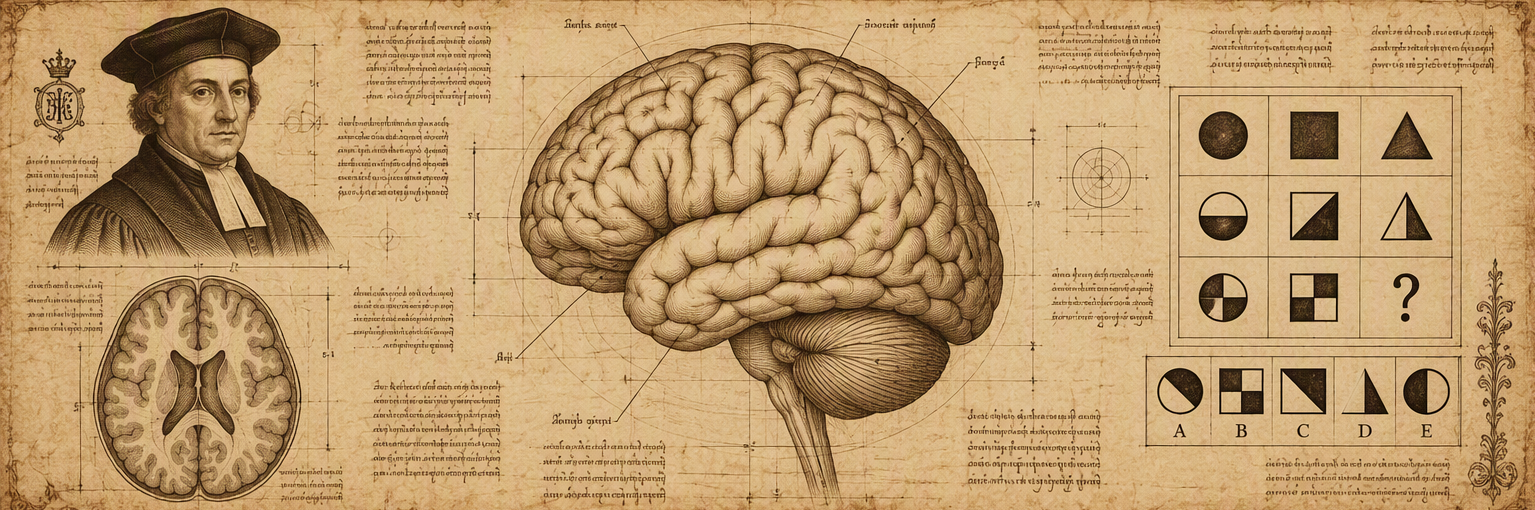
Location Learning Test - Revised
The Location Learning Test - Revised (LLT-R) is a test that can be used to measure episodic spatial memory for object locations. It was originally developed by Dr. Romola Bucks (University of Western Australia) and has since been revised, with an additional administration procedure and an extensive normative data set based on a sample of 647 healthy adults between 18 and 90+ The LLT-R is available in English, Dutch and German through its publisher Hogrefe.
The LLT-R has been validated in patients with dementia, mild cognitive impairment, type 2 diabetes, stroke, HIV and epilepsy. Administration takes less than 10 minutes, plus a delay of 30 minutes. A total displacement score is computed, reflecting the accuracy of memory for the object-location associations across 5 learning trials, a learning index which estimates the learning curve, and a delayed recall performance. The LLT-R comes with a scoring tool that generates a patient report based on the normative data set. An object recognition test is also included.
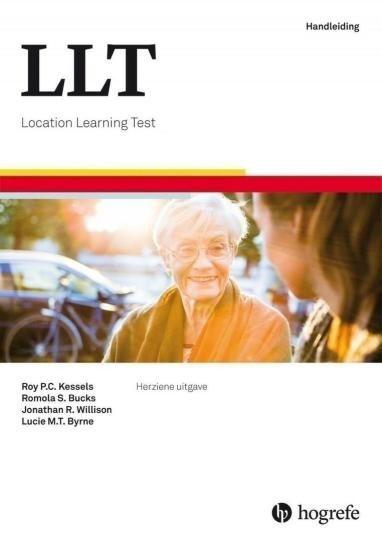
Emotion Recognition Task (ERT)
The ERT, developed by Barbara Montagne, Roy Kessels, David Perrett and Edward de Haan, is a computerized task to assess the perception of facial expressions. The task presents morphed facial expressions that gradually increase in intensity. The participant or patient has to indicate after each morph which emotion is shown by multiple choice. Administration takes about 10 minutes. Regression-based norms are available from a sample of 418 healthy participants from Australia, the Netherlands, Ireland and Germany aged 8-88 (see table below for characteristics). Data of individual participants are stored at the level of each trial for research purposes, but an aggregated PDF report is also generated per individual, showing the individual’s performance as percentile for each emotion as well as the total score. The ERT has been validated in several patient groups, including stroke, autism spectrum disorders, neurosurgery patients, TBI, PTSD, Huntington’s disease, Noonan and Turner syndrome, FTD, Korsakoff's syndrome, MCI and AD. Instructions and interface are available in several languages, including English, Dutch, German, and Portugese.
The ERT is part of the online test environment by Metrisquare and can be run on any computer. For more information on the Metrisquare test platform which you need to run this (free) test, visit this link (international) or this link (Netherlands). The platform meets all requirements for the EU GDPR and comes with a standard Standard GDPR processing agreement. Research and clinical licenses are available. See also this statement.
For the scientific background of this test, see the following paper: Kessels, R.P.C., Montagne, B., Hendriks, A.W., Perrett, D.I, & De Haan, E.H.F. (2014). Assessment of perception of morphed facial expressions using the Emotion Recognition Task (ERT): Normative data from healthy participants aged 8-75. Journal of Neuropsychology, 8, 75-93. https://doi.org/10.2466/pms.104.2.589-598
SYDBAT-NL
De Nederlandse bewerking van de Sydney Language Battery (SYDBAT-NL) bestaat uit dertig zelfstandig naamwoorden van drie of meer lettergrepen (bijvoorbeeld: krokodil, aardappel). De items bestaan uit levende en niet-levende objecten en zijn gerangschikt op moeilijkheidsgraad, gebaseerd op een afnemende frequentie van voorkomen in het dagelijks taalgebruik. De test is gevalideerd voor gebruik bij mensen met (het vermoeden van) primair-progressieve afase, lichte cognitieve stoornissen (MCI) en alzheimerdementie en daarmee geschikt voor gebruik op bijvoorbeeld een geheugenpoli. Er zijn (beperkte) normgegevens beschikbaar en een beslisboom die behulpzaam kan zijn bij het vaststellen van het type PPA.
De SYDBAT-NL bestaat uit vier onderdelen: (1) Benoemen: de patiënt benoemt wat er op een gekleurde foto staat afgebeeld. (2) Nazeggen: de patiënt herhaalt een woord zoals de testleider het heeft gezegd. (3) Begrijpen: de patiënt wijst van de zeven plaatjes de afbeelding aan die overeenkomt met het woord dat door de testleider wordt gezegd. (4) Semantische Associaties: patiënt geeft aan welke van vier afbeeldingen het beste past bij een doelafbeelding.
Voor meer informatie zie onderstaande artikelen (open access):
De materialen van de SYBAT-NL kunt u via deze link vinden (alleen voor gezondheidszorgpsychologen, klinisch neuropsychologen, logopedisten en (klinisch) linguisten). Het betreft de Nederlandse handleiding en het stimulusboek inclusief het scoreformulier als PDF.
Voor onjuiste afname en interpretatie zijn wij als auteurs niet aansprakelijk.
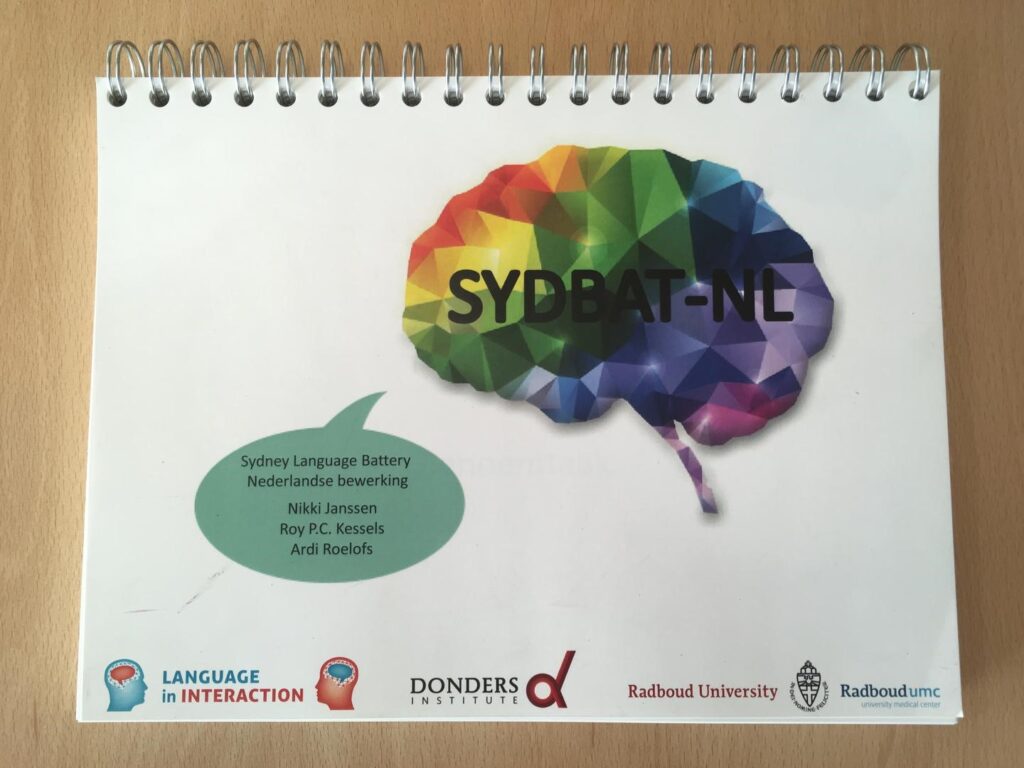
Schaal voor het Cerebellair Cognitief-Affectief Syndroom (CCAS)
De Cerebellaire Cognitieve Affectieve / Schmahmann Syndroom (CCAS) schaal is een screeningsinstrument om het cerebellaire cognitieve affectieve syndroom vast te stellen bij patiënten met cerebellair letsel. Deze meet verschillende cognitieve domeinen: aandacht en concentratie, executieve functies, geheugen, taal, visueel-ruimtelijke vaardigheden, abstractievermogen en neuropsychiatrische symptomen. Afnameduur van deze schaal is ongeveer 10-15 minuten. De hoogst mogelijke ruwe score is 120 punten; de dichotome beoordeling (voldoende/onvoldoende) heeft een maximale score van 10 (d.w.z. 10 tests onvoldoende). Een onvoldoende score van 0 is normaal. Bij een patiënt met een cerebellaire aandoening wijst een onvoldoende score van 1 op mogelijke CCAS, een onvoldoende score van 2 duidt op waarschijnlijke CCAS en een onvoldoende score van 3 of meer is passend bij zekere CCAS. Er bestaan 4 parallelle versies.
De geautoriseerde Nederlands/Vlaamse versie is vertaald en bewerkt door Peter Mariën, Frank Van Overwalle, Bart P.C. van de Warrenburg, Roy P.C. Kessels en Roderick P.P.W.M. Maas, in samenwerking met Jeremy D. Schmahmann. Ook is validatie-onderzoek uitgevoerd. De testinstructie en materialen van de Nederlandstalige CCAS-schaal zijn hier te vinden.